Begin the day with a friendly voice, a companion unobtrusive Plays that song that’s so elusive, and the magic music makes your morning mood
–Rush, “The Spirit Of Radio”
Long ago, when I was on college radio, I used to occasionally get to do my own show during a timeslot that didn’t have to conform to the station’s normal “adult alternative” format – meaning I got to choose my own music for that slot. I wish I had recordings from back then, but I only have memories. But the show I would put on at that time I named “The Spirit Of Radio” after the Rush song, and based on the fact that I tried to bring to the forefront that feeling of listening to the radio and thinking “aw man I haven’t heard this in forever, this is awesome!”
Well, I’ve started playing around with the idea of doing such a show. Unfortunately, to do it legally I need all kinds of licenses and to pay a couple thousand dollars in fees and whatnot, and that’s just not something I’m in a position to do – especially now, which is another story that I’m not getting into at the moment. But I’ve started doing something which is a lot of fun, and having listened back to it I think it’s pretty damned good if I do say so myself, so if you’re reading this and remotely a friend of mine and want to hear more about it, reach out to me and I’ll tell you about it. How do you reach out to me? Well I’m not sure I’ve actually published my email address here before, but fuck it why not… email hidden; JavaScript is required it is. Or come join me in IRC via the https://srhuston.net/irc/ link and I can tell you there. I’d love for friends to hear what I’ve done.
Come in here, dear boy, have a cigar, you’re gonna go far. You’re gonna fly high, you’re never gonna die, You’re gonna make it if you try, they’re gonna love you.
–Pink Floyd, “Have A Cigar”
I’m not sure exactly what triggered it, but recently mesh networking came into my radar and I started researching it a bit. If you don’t know, it’s where people use small radios called LoRa (for Long Range) that operate on unlicensed frequencies – in the US it’s in the 915MHz area, same as many weather stations and other low bandwidth wireless devices – and they create a mesh network out of them. What’s a mesh network? One that is created “ad-hoc” or as needed, based on the neighbors in the area. So if it’s just you and a friend, you have a network of two devices. But if a third comes nearby, then it will join and they’ll repeat messages to each other. As others join, they become part of it, hearing neighbors and routing packets around to keep in touch. And if someone strays further from the others, then they’ll still be connected by whomever is closest. This is a bit of a generalization, but I think you get the idea; and the neat thing is how automatic it all is.
There’s two main systems at use right now, and Meshtastic is the one that was around first and seems more popular. It has downsides that the competition aims to solve, but overall it’s a very robust system for creating an ad-hoc link between people. MeshCore is the main competing system, and where Meshtastic is very freeform, MeshCore aims to create more of an infrastructure – client nodes don’t repeat what they hear in the same way, instead expecting a repeater that is higher up and in a better position to be doing it (which means if you don’t have one, you need to make one). MeshCore appeals to my networking and emergency management brain, and I want to set up some gear to join that at home, but Meshtastic I think is going to solve a more immediate problem, namely that of communication during things like scout events when not everyone is licensed for amateur radio operation and so I can’t just hand out HTs to people. But if you’ve got a device that speaks Bluetooth, I can hand over a small card and you can pair your device to it, even if it doesn’t have cell service, and we can communicate. Some of the devices are completely standalone and don’t even require another device, though unless it’s one of the more expensive ones that look like a Blackberry the method for typing messages is a bit archaic (not quite the level of T9 texting, but not far off).
And the best thing about these devices? They’re extremely inexpensive. You can get a simple LoRa device for Meshtastic use for even $10. Of course you’ll want a better antenna, and maybe a battery, a nicer case, so prices go up from there. But you can even buy a complete device for $40 – compared to a decent HT for amateur use which usually starts around $90 if you’re not looking at the “cheap” radios. I got a Seeed Studio Wio Tracker L1 Pro, and while I was waiting for it to arrive I picked up a Heltec v3 as well. I’ve been using the Wio like a “home repeater” so I can get out further, but will be picking up a node to mount outdoor next month. Seeed Studio also makes the SenseCAP Solar Node P1-Pro which is a self-contained solar unit, and though there’s plenty of plans online for building such things, since I don’t have components on hand to use to make it the Seeed Studio unit works out cheaper than I could buy all the pieces and put it together myself. Combine that with a handful of the T1000-E cards for personal carry and the whole family will have a way to communicate that doesn’t involve cell service or any infrastructure, and I won’t get funny looks when I suggest we use handheld radios for things (since 2/5 of the family don’t have a license anyway, and the others often don’t want to carry a radio with them for most outings).
Oh, and don’t think this means I’m giving up on getting people interested in radio, like the scouts and such. It just means I have an easier inroad to getting them hooked on the fun of it 😀
I’m on a ride, and I want to get off But they won’t slow down the roundabout
–Duran Duran, “The Reflex”
Been a little while, and though I don’t have anything specific to talk about I’ve felt like writing for a couple days now so I might as well do a recap. Mentioned before that I fixed up my turntable and have been enjoying some vinyl; I got a few for Christmas, and Stephanie and I visited one of the shops that she and the kids went to before and I picked up a few more. Looking forward to much more of that as time and money permits, and even making plans for bringing my CD collection in from storage and getting back to having evenings of listening. Yes I can queue up an album and listen streaming as well, but as was mentioned before a good listening session is ritualistic, and streaming doesn’t hit all those right notes all the time.
I’d say I don’t know how I missed mentioning it, but I do know – it was too raw to want to talk about – but by the time of my last post, we’d just said goodbye to Hobbes, my fuzzy orange creamsickle cuddle bug and giver of aggressive affection. I don’t think any of us realized how much he meant to us, and I certainly didn’t realize how much he was helping me keep things together until he no longer was here to do so. He went relatively quickly and I hope without much pain, surrounded by us and getting lots of cuddles and pets, but even thought it was almost two months ago it still hurts a lot. Astrid is doing her best to try to fill the voids but of course she could never, she’s not the same type of kitty. She has been very clingy to me though, I think she can sense that I need it.
One of the biggest problems I feel like I’ve been dealing with lately is my own body, again. In February we had a night with the scouts where we all hung out at the church for fun and fellowship, and due to a series of events (including not being in the right mental state I’m sure) I couldn’t get my hammock stand set up the way I had the previous year and decided I’d sleep on a couch in another room instead. Well, that was a huge mistake. I was OK when I got up Saturday, though I had to run home because I wasn’t feeling well for other reasons (shouldn’t have had the chicken fingers for dinner) and ended up sleeping for a bit at home too since I didn’t sleep well the night before due to aforementioned stomach discomfort. Came back to bring everyone home Saturday afternoon and was still fine, but when I woke up Sunday morning I was stuffed up quite a bit. By Monday it was obvious, my sinuses were completely congested and a bit of post-nasal drip as well. Within a week things were finally subsiding, but as often happens that all triggered a bit of a cough when things had moved down into my chest. A week later we had another trip, and I drove to bring the trailer up to the site and whatnot and was mostly OK – there were some other health issues but the congestion was bearable and controlled with Mucinex and the cough with Halls. Within a week of that, however, the cough got to the point where I’m amost taking a Halls every 30 minutes just to be able to breathe normally. My best guess is a long COVID symptom; see, while I never had a confirmed diagnosis since I didn’t go to a doctor any time it happened before, I’m pretty sure I’ve had COVID twice since 2019 but I’m one of those people who don’t get the extremely serious effects – both times I just had a bit of a cough which was nasty, but went away. But there’s been some things that are lumped into “long COVID” symptoms that I’ve noticed, like the fact that my very mild tinnitus is now ever present and occasionally unbearable. I have a sneaky suspicion that tomorrow, or maybe even today depending on how the rest of the day goes, I’ll be at urgent care to see what kind of treatment(s) I can get to try to end this, because the cough gets bad enough that all the dashboard lights come on at once. And the worst thing is, I don’t think there’s anything in there that needs to come out, so this is just an overactive reflex causing me to eat Halls like candy. [Points to post title & image]… eh? Eh. Worth a shot.
So with all of that going on, I haven’t really done much of anything else with.. well, anything. I have a partially finished project sitting on the workbench that Michael and I still have to talk about. The hot tub hasn’t been looked at in months and is probably completely out of whack again. Another project is leaning against the door as it has been for over a year (which should have been done by now, but we ended up not being able to do a Pinewood Derby this year so the clock reset on that one). Other to-do items just keep getting pushed back, and with my body again failing me in multiple ways and nothing else letting up either I haven’t stopped feeling like I’m drowning in two months. I want to do stuff for my other big project too, but I need help with it and when I can’t even focus on what I’m doing I don’t want to ask for it and then not be able to pull my own weight at the same time (since it’ll be a combined effort, Stephanie has the tools and ability to use them for what I need but I need to be able to influence decisions and discuss things to provide input). About the only “new” thing is that for some reason I decided to download Far Cry 6 and give it a try, and ended up really enjoying the game; I finished the playthrough and started a “New Game Plus” run right after, and I’ve almost finished all the collection items on that with having only done enough story missions to unlock some locations and whatnot. And I’ve learned a new list of curse words from it as well, which I guess is another plus?
How many roads must a man walk down Before you call him a man?
–Bob Dylan, “Blowin’ In the Wind”
I had some questions about our air conditioning system, and now a chilling mystery has finally been solved.
We had our air conditioner fail just before the start of the last summer season. Fortunately we figured that out very early, and had the technicians come out and verify it was dead (lost its charge, and given the age it wasn’t deemed worth fixing.. I balked, but kinda agreed). They were able to schedule us for a new install pretty quickly, and we had everything wrapped up within a week of the summer temps getting pretty outrageous here, so I was happy with how it turned out.
One thing I noticed with the new system is that it uses a newer refrigerant as well. Now I’m used to R-22 not being “the thing” anymore, and even R-410A is on the way out, but I’d never heard of R-454B. The Wikipedia page on it is an interesting read, if only because it mentions one of the constituents of it is R-32, which is being phased out in some places and thus endangering R-410A’s usage (which makes you wonder why use another blend containing it). And of course the bit that as of last year, there’s a shortage of it. If I’d read that before they suggested this unit I might have suggested another model…
Anyway, things worked great for the summer, and now it’s winter time. We’re not using the A/C of course, and our heating is from hydronic baseboard so we have no need to run the indoor unit at all. So imagine my confusion some time ago when I was sitting at my desk and suddenly realized the fan was running. I wondered if the thermostat was messed up and checked outside, but the compressor and outdoor unit wasn’t engaged, just the fan. I flipped the fan switch from its normal “AUTO” to the “ON” position and back, but no difference. So thinking the thermostat might be more broken than I thought, I pulled it off the wall. When the fan kept going, now I knew something more interesting was going on. And yes, for those keeping track, that would be the Confucius definition of “interesting.”
After a bit of research, I came to a conclusion. See, since the refrigerant in this unit is slightly flammable, there’s a “dissipation sensor” inside the indoor unit. If it detects a flammable gas present, it forces the compressor to stay off and turns the fan on for about 15 minutes. Sure enough, when one of these episodes happened I was able to note the start time and the end time was almost exactly 15 minutes later. Ok, now I know why the fan is coming on, but why does it think it has to come on? Well, the board in the unit would tell me via a test light – if it was flashing a certain pattern, that would mean it thought it detected gas present and was turning on. So I’d now have the information needed to tell the service folks that either we have a leak in our system and need it fixed and recharged, or we need the sensor or board replaced because it’s faulty. But next time it went off, I couldn’t get upstairs in time to check it, and by the time I did get there I realized I didn’t know what side of the unit to open to get to the control board anyway, so I went back to the computer to look up more information. And that’s when I made the next discovery.
After searching for more information on the dissipation board I found a Reddit post that sounded like I could have written it myself based on what was happening. But it was the OP’s follow-up in a comment that struck the right chord:
While my sensor was installed wrong, it turns out that wasn’t the cause of the problem. Carrier just issued TIC2025-035 that says this is the intended behavior of the sensor calibration electronics. The new coolant is more flammable and requires more vigilant monitoring. If the fan doesn’t run for 15 minutes over a 1 week span it does so to clear the vents and recalibrate. Unfortunately this was apparently designed without thinking about setups like mine where the vents are closed during the winter and the air in the vents is approaching 5°F.
Unfortunately I’ve not been able to find that TIC myself, but this all seems to make sense. So at least now I have an answer on WTF is going on, and why my air conditioner thinks it’s appropriate to blow cold air on me once a week. And now I have plans to wire up a switch in the room below where the air handler is so that I can manually switch it off during the winter when it’s not needed (yes I could use the breaker in the basement, but that’s harder to get to, and so if I decide I want to turn it on one day it would be harder to get to it easily.. and breakers aren’t meant to be switches).
Many years ago, I set up this computer. It’s… hm. Alright, maybe that’s not where I should start. No, I should probably go back from the start now, otherwise I’m going to have to do this in like a flashback thing, and those get messy. Ok, I’ll try again.
There’s a lot of things one can do in amateur radio, and I enjoy quite a few different aspects of the hobby. Of course there’s talking to people, there’s tinkering with electronics, but you may not know that some advances in technology came about because of hams experimenting with things to see how they’d work. One such thing that hams took from the commercial realm and started toying with is called AX.25, which is “a data link layer protocol” used in packet radio. Without going into all the details, it means that hams can use their radios with fairly simple devices attached – like the kind we used to use to call up our Internet provider and get online, remember that one guys? Guys? Fuck we’re old…
Anyway, with a simple modem – in this case called a TNC or Terminal Node Controller – you can send and receive packets of data over the air. This created packet BBSs… hey remember those too? Ugh, nevermind. Well packet traffic is good for getting data from one point to another, especially if you have other stations on the same frequency that can bounce your signal further along than you can on your own, but there’s limitations to things. Again, I’m glossing over a lot of this because it’s not really important to what I did today, and I can already feel this is longer than it should be 😀
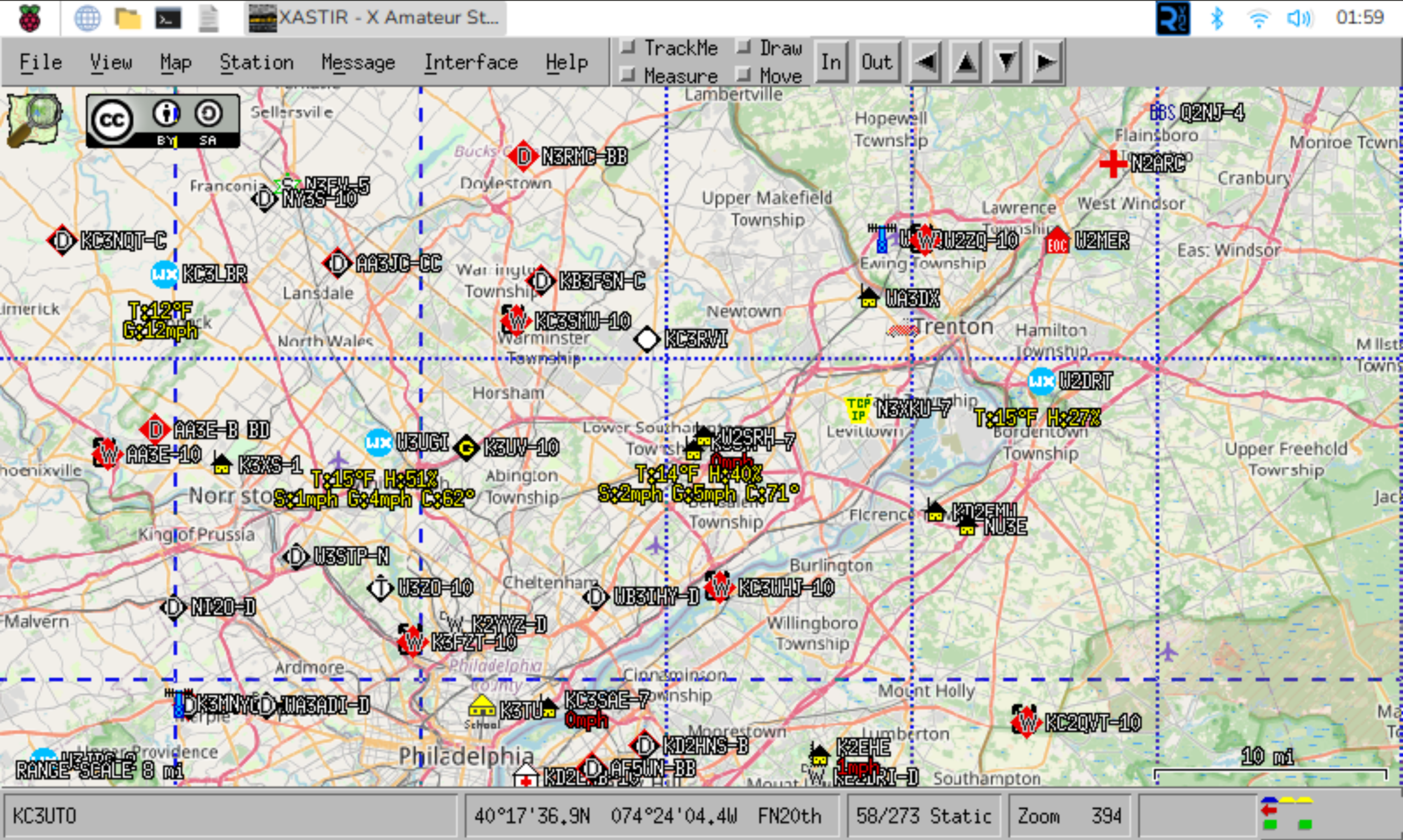
Back in the 1980s, Bob Bruninga – a research engineer at the US Naval Academy – came up with a way to track things using packets like this, and it evolved a few times until the 1990s when he started to test it with some amateur stuff as well. Eventually calling it APRS (originally the Automatic Position Reporting System, later with Packet replacing Position since it was meant to be more than just position reports) it was designed to use AX.25 packets in an “unconnected” way. No station was actually talking to another station directly, they just kinda “said” what they had to, and other stations that heard could do something with that or ignore it. Mostly, those packets had things like a position report (or GPS coordinates) but could also carry other information such as weather or short messages. But the packet also contained other bits of information about how “far” the transmitter would like their data to travel, and other stations might take the original packet and repeat it, changing it slightly, for example if it was a station that was high on a mountain with larger coverage. This is called “digipeating” (for digitally repeating) and digipeaters are a big part of the APRS network. With them, a user with a small handheld radio, or even a portable tracker, has a better chance of their signal getting heard by other stations. In the image above, you can see a bunch of stations positions marked on the map, and if one of them had been moving you’d even see a “trail” from it showing the path it took.
Later, stations were set up in an Internet linked manner and called “Igates”. The purpose of an Igate is to take the traffic heard on the radio and put it onto the Internet where it could be “heard” anywhere around the world by anyone interested. This allows for a more robust backend in some cases, where there might be good Internet service but spotty APRS coverage otherwise, so that the traffic generated in that area can still be seen elsewhere. Igates can be configured to also send some traffic from the Internet into the RF area, though that must of course be done with caution so as to not overwhelm the local area with junk traffic. Nobody needs to be hearing about your “special” weekly net when they’re too far away to actually hear it or join it anyway (and unfortunately APRS spammers exist).
Ok, I think that’s enough back story. And at this point I’ve probably taken up more time than you were willing to give me, so I’ll be surprised if you keep reading. But maybe I’ve only piqued your interest and you’d like to hear more over a cup of coffee. Well, go pour one and I’ll keep typing. So years ago I had an APRS station running at our last house, and it worked pretty well, but the software was running on my computer. The problem with that is that once I got a radio in the truck that could also do APRS, there was no way for Stephanie to use the software to send me a message or even look to see where I am (without looking on the website, of course). Plus it meant if I had to do something on the computer that took it offline, the APRS station went offline too. With Raspberry Pi machines being only about $35, and accessories not too much more at the time, I picked up a 7″ touchscreen display that the rPi 3B+ would mount right onto and configured them to run Raspbian Linux, installed my favorite APRS client Xastir on there, and now had the benefit that if my wife (and later my daughter) wanted to see what was up they could just touch the screen to wake it, and even use the nearby Bluetooth keyboard to send a message to me in the truck. In Morrisville, the station wasn’t highly useful because there was plenty of other stuff nearby, but I enjoyed running it. Once I moved to Trevose, however, I found that there was a bit of a dead spot near my house (which is also near where Street Road, I-95, and the PA Turnpike meet). So here, the station hears a lot of daily commuters, and helps to get their traffic not only heard onto the Internet but even repeated locally which gets heard across a large area. Oh yeah, did I mention that my station’s packets are heard easily in Somerset, Gloucester, and Ocean Counties in NJ as well as Northampton and Philadelphia Counties in PA? I’m in a really good spot here, and I love seeing that my station is able to help a lot of others.
But, I took it offline today, because I had to update the OS on it. I hadn’t in a long time, in part because I just wasn’t paying attention to it, and then when I finally did the OS was old enough that there wasn’t a clean upgrade path and a full reinstall was the best choice. I tried using a separate SD card – so if things went south I could put the old one back in – and it’s good that I did because things went south when I tried to copy data off the old card onto the new one and found it filled up. Decided to get a larger one, but that was sometime in August I believe, and the “Finish APRS upgrade” task was on my list since then. Well today, being I was home with three kids in various stages of flu-ness and not wanting to leave my safe area in the shack, I pulled the machine off the shelf and started working on it. Got sidetracked when the power supply I was using didn’t have quite enough oomph, and then again for dinner later on, but finally this evening I got everything setup and running again. And then after a shower I decided to write about it, which is why I’m finishing this up at 3am. But I got it done before the storm hit, which is nice. Oh, and not shown in that screen capture above, because if I left the NWS alert part on the whole screen would just be a red blob that says “ALERT” due to the impending snowfall. Which hasn’t started yet. Which also annoys me for various other reasons. Hopefully not as much as reading all of that just to hear “I upgraded my computer today” but.. well I thought it was interesting. Maybe you will too.
With half the people in the house under the weather – and myself not that great, just slightly better than them right now – I’m sitting home looking at my desks and waiting for the impending storm outside. So I decided to challenge myself to get the APRS computer rebuilt before the storm arrives and I want it online and fully functional. On the second write of the OS to the new SD card since apparently the power supply I was using was a bit underpowered and it kept rebooting, so who knows if anything got hosed in all that. Rather start over than find out a month from now something is horribly broken under the hood.
No I don’t know where I’m going But, I sure know where I’ve been Hanging on the promises In songs of yesterday And I’ve made up my mind I ain’t wasting no more time
–Whitesnake, “Here I Go Again”
I did a thing.
For a while I keep thinking about doing a podcast of some sort, but always thought of the reasons why not to. And I might go over them here, but the shorter form of this is to say that last night while talking with Stephanie, and after having gone over some of these ideas and hang-ups, in mid sip of my whiskey I came up with what I think is a brilliant idea for a title. I mentioned it to her with a smile, and her first words were “make sure the domain is available.” I love that woman.
It was, and so I bought it, and even searched and found nothing else using that title on Google at all. So I should be in the clear for .. well, a lot of things. Next is to set up the foundation for all of it – the website, various accounts that might want or need to be associated, all the social media stuff most of which I have no idea about – and then start talking about it. Or maybe I start recording some and get a few “in the can” before talking or promoting it at all, and then suddenly a wild podcast appears.
Here’s hoping it’s super effective. Oh, and bonus points if you know how the photo is related.
I’m going, I’m going Where the water tastes like wine I’m going where the water tastes like wine We can jump in the water Stay drunk all the time
–Canned Heat, “Going Up The Country”
I don’t remember the last time I bought canned air dusters, or canned air (not to be confused with Perri-Air), but I do remember when I took out the last unused one it felt half empty. And that one just about ran out, so I needed to get more. I don’t use it often, obviously, but part of that was self-fulfilling – if I use it up, I don’t have any, so I tend to not use it unless I don’t have other options. I do have an electronics safe vacuum as well, which is wonderful, but sometimes you just need to blast the crap out of somewhere.
So I went on a search to see if there was a good alternative yet; years ago I bought this small can with a valve on the bottom and a bundled air compressor that was obnoxiously noisy, with the promise I could just refill it when I needed to. In practice, it worked for a few seconds and quickly lost useful pressure, and then you had to endure the noise of refilling it. That was, in my mind, not a viable option.
I then found that quite a few companies make electric (really battery) powered handheld devices for this purpose, and after enduring a few videos on the topic (and deleting them from my history, because otherwise every freaking video is a review of another one of these things), I found one from Wolfbox which had the highest recommendations from various places, good specs, and a decent price. But before buying it, I found there’s a newer version, the MF200, which is about the same price when I placed the order but has the ability to get additional batteries for a longer run time and swap them around. While I don’t anticipate needing that functionality, it does sound interesting, plus the unit was a little beefier than the original (and can set flat on its base, so I kinda preferred the ergonomics too). Add to cart, place order, research complete!
Last night I tested it, and from across the room I just gave it a quick burst and about two seconds later the youngest reeled back in his chair from the blast of air he got hit with. Definitely has the power that a can of air would have, and my hand doesn’t start to freeze when using it either which makes it more useful since I don’t have to stop and wait for the can to warm up and the liquid inside to boil off and pressurize things again. This afternoon when he finished vacuuming and took the canister out to dump it, I grabbed the filter from under the canister and took it to the porch. Maybe a minute later I had a perfectly clean filter to put back in.
Now I’m looking forward to using it more, because there’s a lot of times I would have used a can of air to clean things off but thought “no, if I do that, I’ll run out of it and not have it for the things that really need it.” Just have to remember that some times it would be better to use the vacuum and trap the dust…
There you go man Keep as cool as you can Face piles of trials with smiles It riles them to believe That you perceive the web they weave And keep on thinking free
–The Moody Blues, “In The Beginning”
I’m tired of the bullshit. Side note, I wrote this late in the evening after witnessing some of that bullshit, and I’m not proofreading it today. So there might be some incomplete thoughts here, but… I know if I sit on it to fine tune and polish it, I’ll either keep repeating myself or just never hit save. So here it is.
Everyone wants to rant about how evil “AI” is. And I get it, I really do. But let’s start with some basics. First off, none of this is “Artificial Intelligence.” What you’re complaining about is called a “Large Language Model” and it’s not intelligent at all. Step outside of its training and it has no idea what to do, and doesn’t even have an idea of how to figure out what it might need to know to figure out how to answer you. So that’s the first issue I have when people whine about AI, is that what you’re whining about isn’t even AI.
Ok, next. Yes, LLMs have been fed with all kinds of things, including things that are copyrighted. They’ve been fed with copyrighted text works, copyrighted images, all manner of stuff that means they’re rife with junk and ready to start creating “plagiarized” works that are based on other things. On that point, I can fully agree that a LLM fed with copyrighted works and asked to churn out other things that are based on copyright are bad, and are creating problems for artists.
But some of the arguments against “AI” are completely bogus. They use 500 million gallons of drinking water a day? No, not a chance in hell. Hank Green did a nice video on how crappy some of these numbers are.
And probably the worst thing is some of the crap I see in some circles where anything remotely thought to be “AI” is shunned and the person posting it shunned for doing so. First off, it’s becoming this generations “that looks ‘shopped” and getting annoying. The header image on this site now? It’s been “generated” by AI. In that I took the image, some 20 or so years ago, with a shitty camera phone, and told ChatGPT to clean it up so it’s a nicer resolution but retains the scan lines and bloom that are reminiscent of a photo of a CRT. And it did. And I’m quite happy with it. Because I’ve always thought that was hilarious, that the BIOS detected a problem with the input device, then wanted me to use that same input device to signal that it should continue.
I’ve had some long conversations with ChatGPT. Some topics were technical, some were personal. Some were about programming things, some about hardware things, some about life things. Some were about trying to find an old comic that I remember seeing and can’t locate. Some I left thinking, “well that wasn’t much help,” while others I left wondering how it knew exactly what I needed to hear.
I understand there’s a lot about “AI” right now that people are unsure of. But I really wish they’d stop pushing back against it as vehemently as they are, because it really feels like the buggy whip industry complaints when the automobile was first introduced, and I can’t help but think that those whining are going to be the laughing stock and left behind when things continue to move forward and I don’t want to see that happen. Sure, the technology has its problems, but every tech does, and we need to see how the tool works best for everyone and use it as such, not throw it out because we’re afraid of it, annoyed by it, or just don’t yike it.
I know this isn’t really a fully fleshed out discussion. But I saw once again recently where something was posted that resulted in a bunch of “that looks like AI” bullshit, and .. I’m just sick and tired of whiny cunts. So rather than ranting at them, I’m ranting in general. And I’m doing it here instead of at ChatGPT. So… go me?
Open doors we find our way We look, we see, we smile Surely day-breaks cross our path And stay maybe a while
–Yes, “Ritual (Nous Sommes du Soleil)”
Been a while, as often happens. I’ll summarize a few things since that’s what’s on my mind and what brings me here today 😀
Emily really wanted the Epic limited edition boxed set and we got it for her for Christmas; but my old turntable was still not operational since we moved here, as the Yamaha receiver we had didn’t have a phone pre-amp – though it subsequently died anyway – and the JVC we used to use before it wasn’t working well anyway and wasn’t usable for things after all. So I finally bit the bullet and picked up a new receiver, then got the equipment I knew I’d need to get the turntable up to snuff: a new cartridge since I never replaced the one on it for the entire time I used it (got a new stylus and kept using that), and a new belt since the old one was .. well, old. Got things sorted out, pulled the LPs out of the cabinet they were shoved into and organized them (and found out about Discogs, which will be great next time I go to the thrift store), even played a few albums to test things out. Christmas day she was thrilled, and David got a couple albums as well since once the kids knew vinyl was an option they put some on their wish lists. Parenting win. I got some new records too, so overall win.
Also on my wish list was a new weather station, an Ambient Weather WS-2000, because the one I got a few years ago started acting strange – doing things like reporting the temperature some 20-30 degrees lower than it was, for example. Some things said that could be a result of low batteries, and it had been up long enough that I thought that might be an issue too, so this spring/summer I pulled it down off the garage and replaced them. Unfortunately, things didn’t improve, so I figured it was time to shop for a replacement. Well I got it for Christmas, and currently have it sitting on my front porch bungeed to the railing while I test things out, but I’ve already set it up in weewx replacing the La Crosse one. Tomorrow I plan to be out, though the wind will be pretty high anyway, so on Wednesday I’m hoping I can climb up and swap out the old one for the new one. Then I can ring in the new year with new weather measurements that will be more accurate than the -40F that the old one said it was this morning. And you can see all the published goodness here: https://srhuston.net/weather/
Oh, and the quote and image? I was listening to Tales from Topographic Oceans as I wrote it. And listening to music on vinyl is a kind of ritual, if you do it right. And I did. And it was. And it was glorious.










Comments
Join the conversation on Bluesky